The Tea Counter I Keep Going Back To, and What It Changed at Home
There are plenty of English write-ups of Sakurai Japanese Tea Experience, and most of them are good. They are also, almost without exception, written by someone who went once.
I have been going for seven years. I only found it because a friend was managing HIGASHIYA MAN, a few streets away in Aoyama, and told me to go — the two places come out of the same studio, which I did not know at the time and which explains a lot in hindsight.
This is not a review, then. It is the other thing — what happens when you sit at the same counter enough times that you stop watching it as a performance and start noticing it as a method. Nearly everything I do with tea at home came from there, and most of it I picked up without being taught.
What the counter actually is
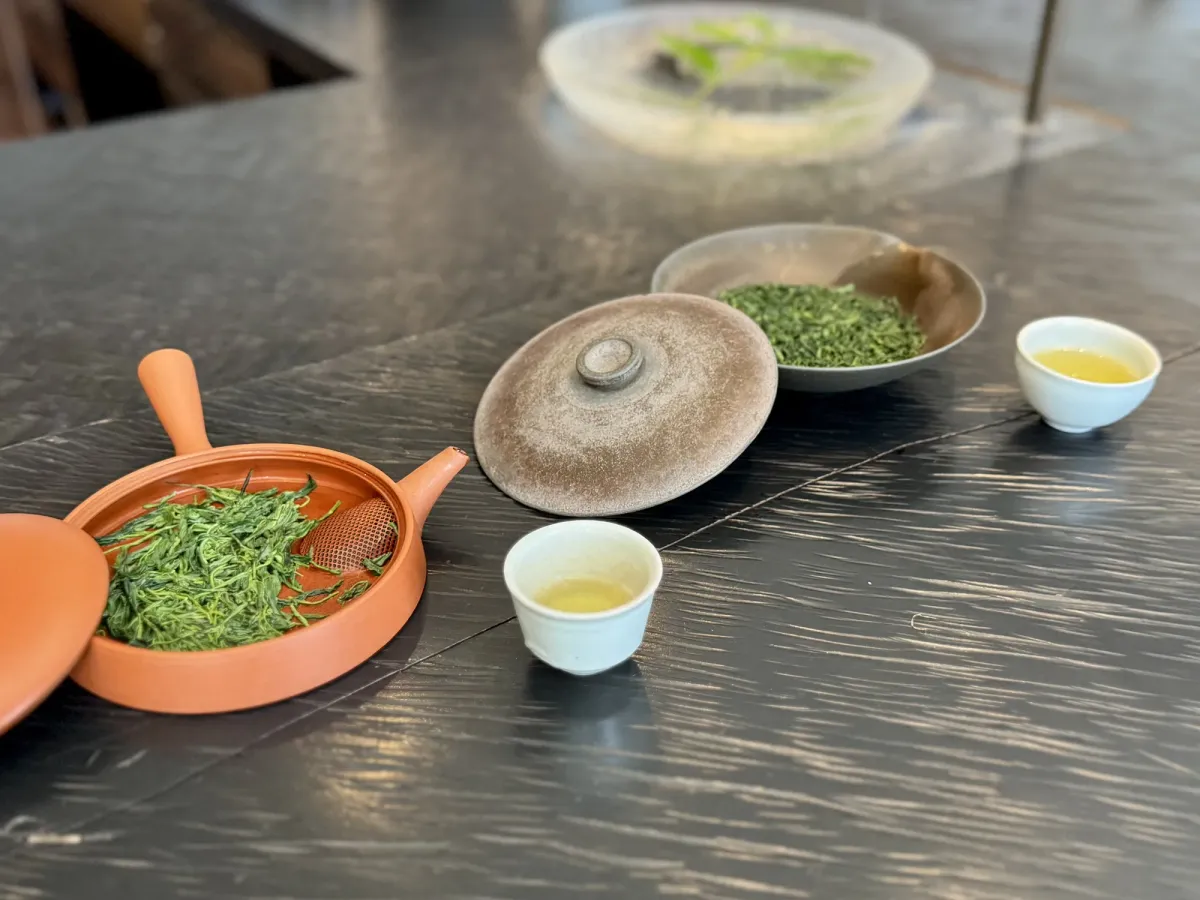
It sits on the fifth floor of the Spiral building in Minami-Aoyama, behind a room of tea tins, and it is laid out like a bar: a long wooden counter, a handful of seats, and everything happening in front of you rather than behind a door.
That layout is the point. A tea house where the work is hidden asks you to receive. A counter asks you to watch.
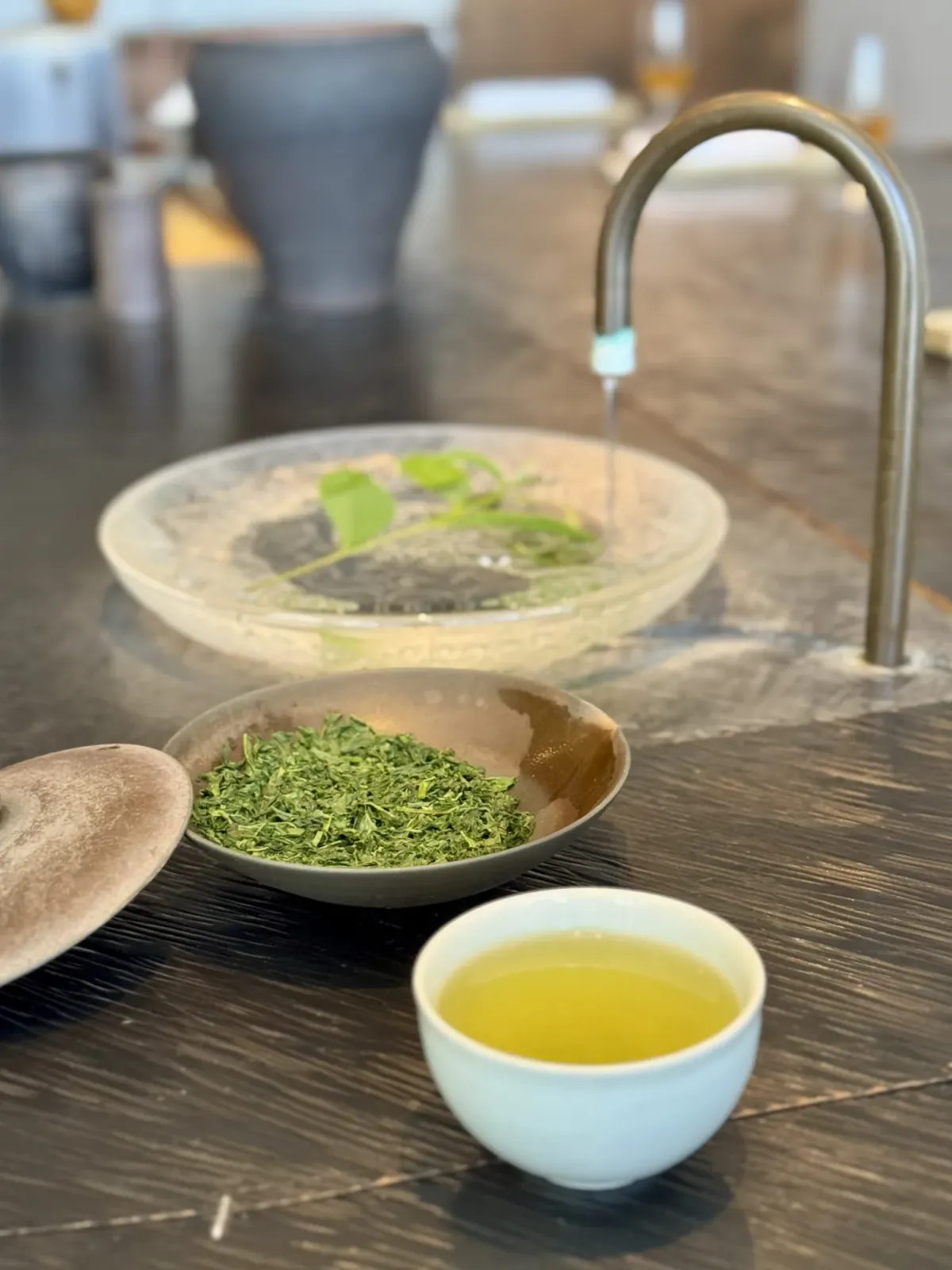
There is no ceremony in the formal sense. Nobody kneels, nothing is recited. What there is instead is a sequence of small decisions made deliberately and in the open — this leaf, this temperature, this much, this long — and repeated in front of you until you begin to see that they are decisions at all.
That was the thing I did not expect. I had assumed good tea was a matter of good leaves. It is mostly a matter of choices that most of us make by default without noticing we are making them.
The leaves are food
This is the part I have never seen in any English write-up, and it is the single thing that changed my kitchen the most.
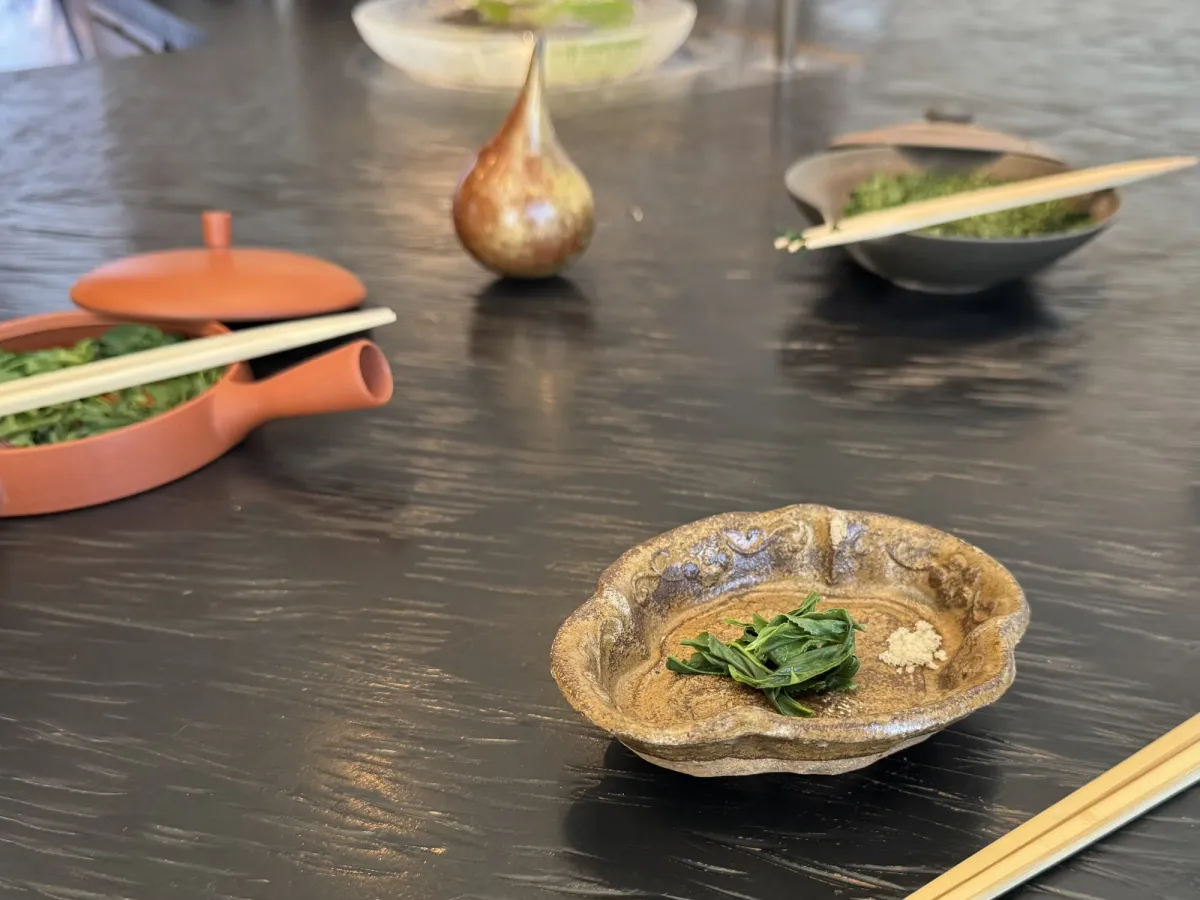
When the leaves are finished — after the second or third pour, once there is nothing left worth extracting — they come back to you on a dish, with a little salt, to eat.
The first time it happened my honest reaction was you can eat this? Not resistance exactly. More that a category I had never questioned turned out to be wrong.
They are good. Soft, deeply green, faintly bitter, closer to a vegetable than to anything you would call a garnish. A little salt, a little ponzu. And you realise you have been throwing away the solid half of something you paid attention to for twenty minutes.
Two things worth knowing before you try it.
It works because it is gyokuro. Gyokuro is shaded for weeks before picking, which is what makes the leaf soft and sweet enough to eat. A robust everyday sencha leaf is a tougher, more astringent thing, and it is not the same proposition.
Do not eat many. The leaf holds the caffeine that did not make it into your cup, so a dish of steeped gyokuro is a considerably stronger dose than the tea was. A few is a course. A bowlful is a mistake.
I do not do this at home — I have not been brewing gyokuro. When I do, I will.
What I took home, literally
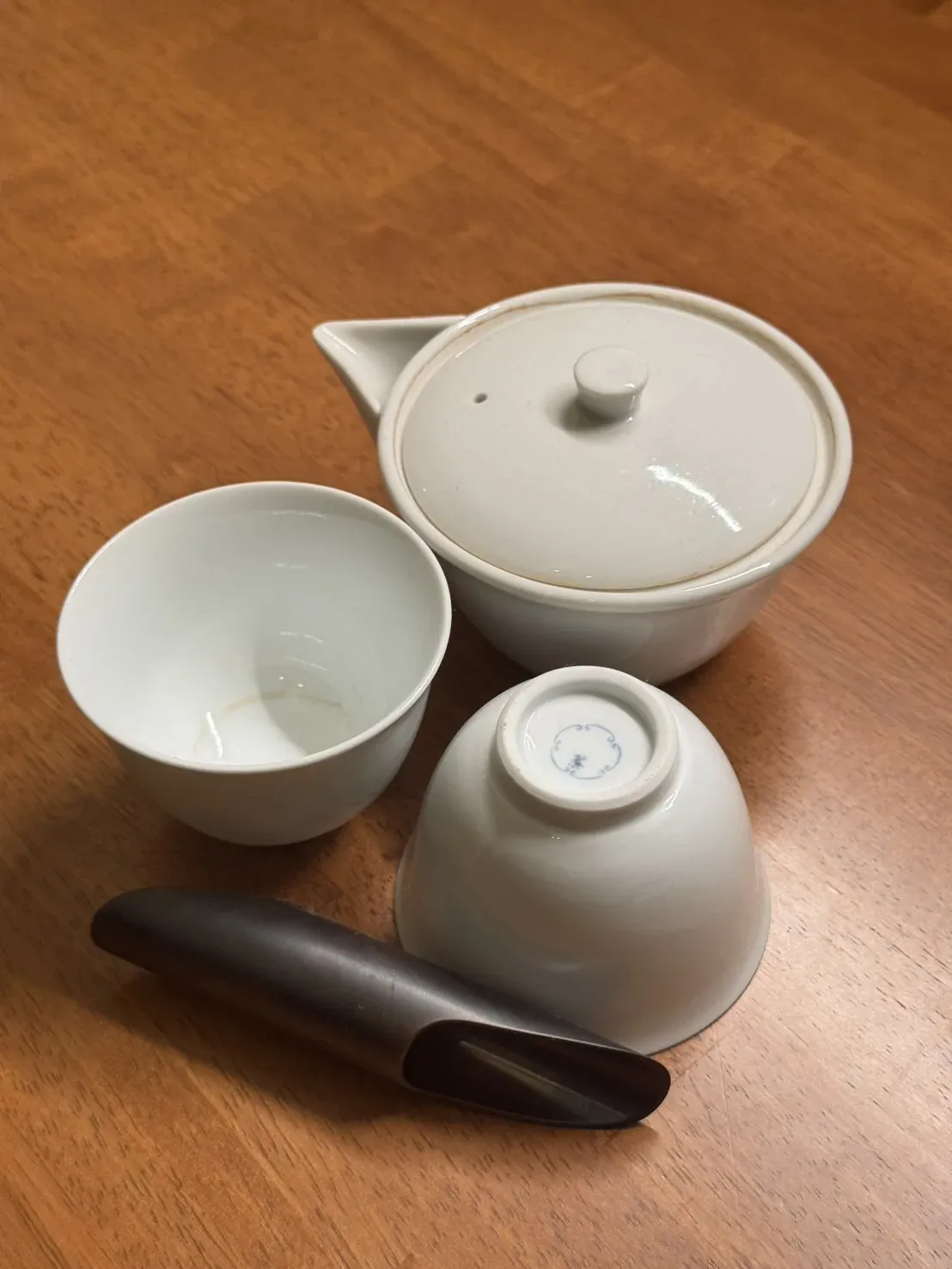
Three things came home from that counter, and they were not bought in one go. A small handleless pot, two cups, and a wooden tea scoop.
The pot is the interesting one, and if you have only ever seen a Japanese teapot with a side handle it will look like a mistake. It has a spout, a lid, and nothing to hold it by.
That is not a design flourish. A handleless pot has no handle because it is built for tea brewed at a temperature low enough that the pot never gets hot enough to burn you. Gyokuro is brewed at around 50°C; a good sencha at around 70°C. At those temperatures a bare porcelain body is perfectly comfortable in both hands. The absence of a handle is the instruction. You cannot use one of these and also pour boiling water into it, because you would not be able to pick it up.
I did not understand that when I bought it. I understood it the first time I used it.
Japanese has two names for pots in this family — hōhin and shiboridashi — and the distinction is mostly about whether there is a built-in strainer at the spout. I never asked which one mine is, and for the purposes of this article it does not matter: the reason the handle is missing is the same either way. If you go looking for one, search both words.
What changed in my kitchen
I stopped using boiling water
This is the change that made every other one possible.
I used to do what most people do: boil the kettle, pour it straight over the leaves, drink it. Now the water goes into the pot first and waits, and I drink at somewhere around 70–80°C.
The difference is not subtle and it is not subjective. Boiling water strips a Japanese green leaf — it pulls the bitterness and the astringency out ahead of everything else, and you end up with a cup that tastes like a general idea of “green tea”. Below 80°C those compounds come out much more slowly, and the sweetness and the umami arrive first. It is the same leaf. It is not the same drink.
If you change one thing after reading this, change this one. It costs nothing.
Small cups, from the first pour
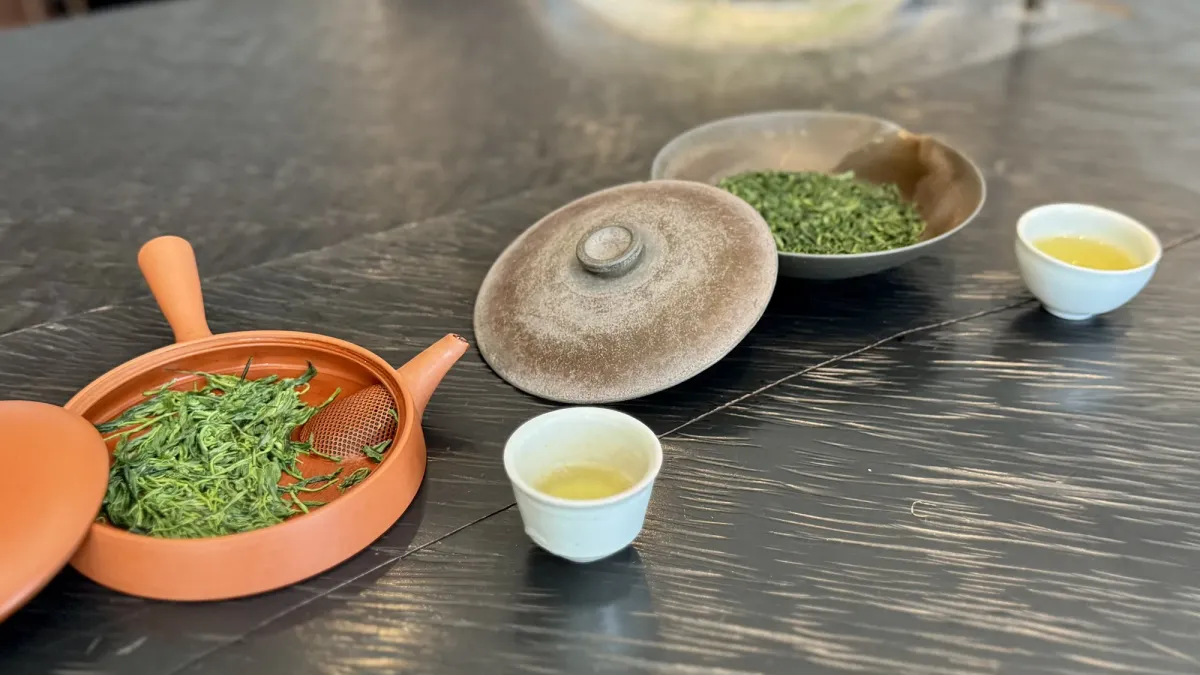
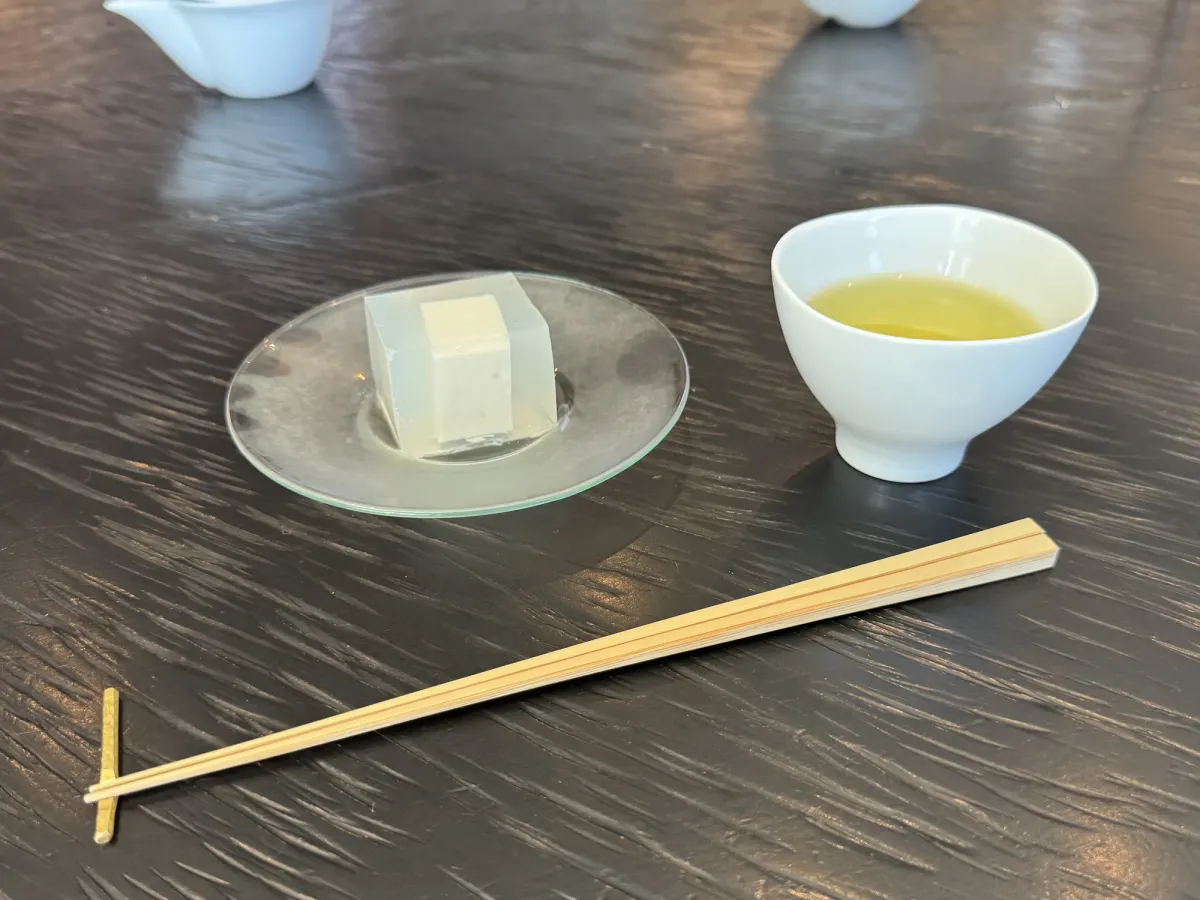
Look again at the cups on the counter in the photo at the top of this page. They hold about two mouthfuls. That is not a stylistic choice.
The cups at the counter are small enough that a serving is two or three mouthfuls, and I use small ones at home now too — from the first steep, not just for the concentrated ones.
A big mug forces a compromise. You need enough liquid to fill it, so you either use more leaf than you meant to or you pour longer than the leaf wanted. A small cup lets the leaf decide how long it steeps, and it means the tea is still at the temperature you chose when you get to the bottom of it.
Three to five grams, because I am one person
I drink alone, so I use 3–5 g of leaf. Having a scoop that holds a known amount turned out to matter more than I expected — it stopped the quantity from drifting upward every time I was in a hurry.
I buy less tea, more often than I used to think about it
Once a month, and only from two places: the counter itself, or Cha no Ha in the basement of Matsuya in Ginza.
That sounds restrictive. It is the opposite — buying a small amount monthly means the tea in my house is always recent, which matters far more for a Japanese green tea than which shop it came from. Green tea does not improve on a shelf.
(Cha no Ha got its own piece in the end — a tea room with a tree in it, under a department store.)
The second and third steeps are the point
This is the change I did not see coming.
I used to treat the second steep as leftovers — the thing you do because throwing the leaf away after one pour feels wasteful. At the counter, the later pours are clearly not an afterthought; they are the part the whole sequence has been walking towards.
Now I drink the first cup for the tea, and the second and third for something else. They are lighter, quieter, less about flavour. Somewhere in the second pour the day stops being loud. I do not have a better way to say it than that: the first cup is for tasting, and the ones after it are for being washed out and filled back up.
The one thing that has not changed
I still brew with whatever kyusu I happen to have. I have never sat down and chosen one — matched a pot to a tea, or to the way I actually drink — and I would like to.
That is a real gap and I am not going to pretend otherwise. It is also, more or less, why this site exists.
The sweets are not decoration
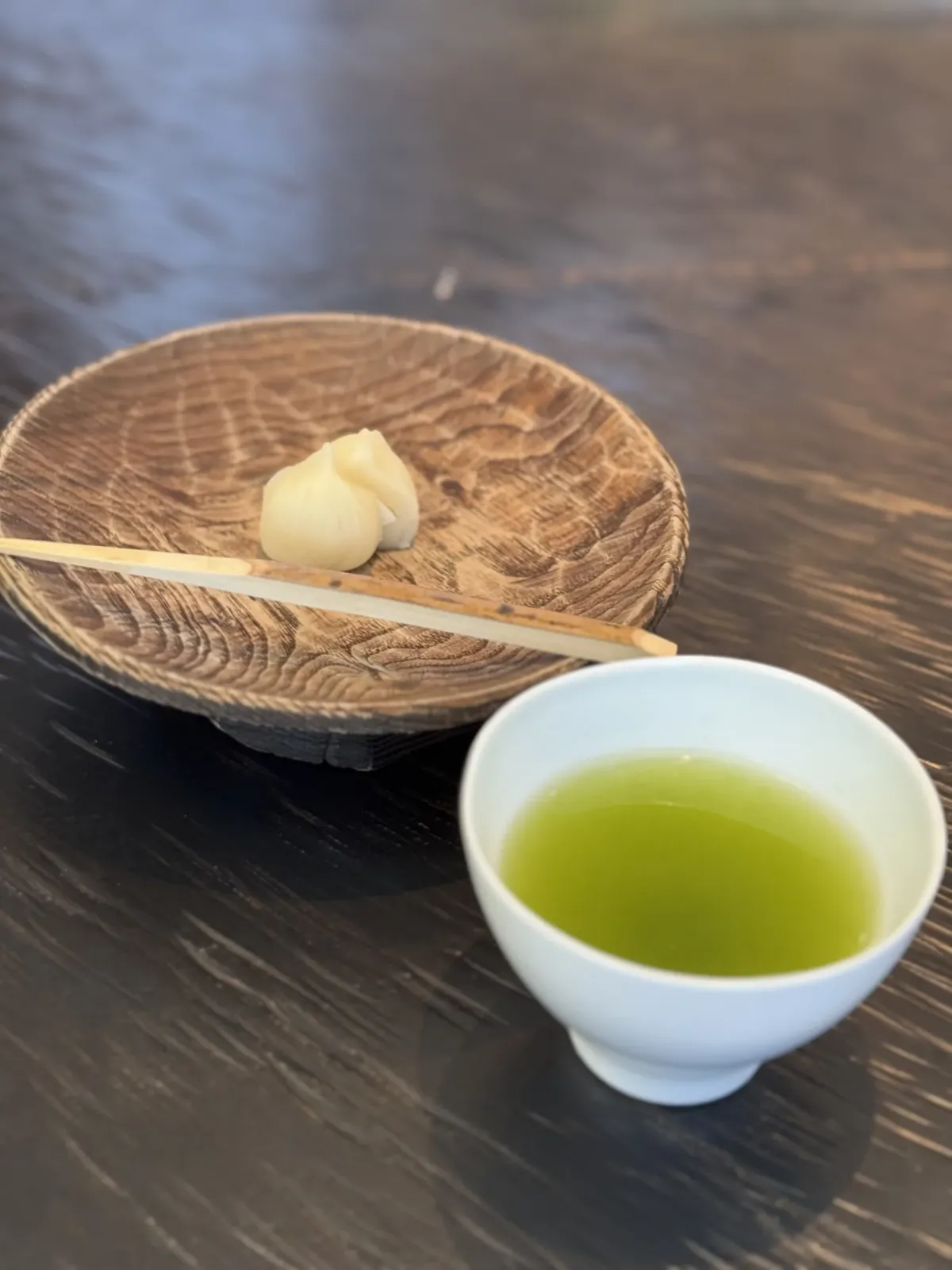
A wagashi at this counter is not there to be nice with the tea. It arrives between the first steep and the second, and once you notice that, the whole sequence reorganises itself around it.
Think about what that placement does. The first cup lands on a clean palate, with nothing sweet anywhere near it — so the first steep is purely about the tea, which is the most concentrated and the most particular it will ever be. Then the sweet resets you. And the second pour arrives into a mouth that is no longer trying to analyse anything.
It took me an embarrassingly long time to see this as deliberate rather than as service. The first cup is for the tea. That is what I think now, and the sweet is what marks the end of that part.
Why this is the first thing on this site
I write here about kettles and teapots and how to keep them alive. It would be reasonable to assume that started with the objects. It did not. It started with a room.
The tea at that counter is very good. But it is not really the tea I keep going back for. It is the hour — a quiet one, in which the only thing being asked of you is to attend to one small thing at a time, and in which that is enough.
There is an old phrase for this in Japanese tea: shichū no sankyo, 市中の山居. A mountain dwelling in the middle of the city.
It comes from the tea culture of the late sixteenth century, from merchants in Kyoto and Sakai who had no way to leave the city and built rooms that gave them the feeling of having left. Not by importing nature — by suggesting it, with earth walls and raw timber and restraint, until the noise outside stopped registering. Nature felt through the mind rather than looked at.
That is exactly what the fifth floor in Aoyama is. There is a whole city on the other side of the wall and you cannot hear any of it.
And what I have been doing for seven years, slowly and not always successfully, is trying to bring that hour home. Not to recreate the counter — I could not and would not want to — but to build the habit of sitting down with tea in my own kitchen and letting it take the time it takes.
Every guide on this site is, in some form, part of that attempt. The kettle articles and the teapot articles are downstream of one counter in Aoyama.
If you are going
Reserve. There are only a handful of seats and they are not the kind you wait for.
Do not order the thing you already know you like. The point of a counter is that someone else is making the decisions, and you learn more from a tea you would not have chosen.
And when the leaves come back on a dish at the end, eat them.
Menus, hours and reservations are on the tea house’s own site, sakurai-tea.jp. I deliberately have not put prices here, because they change and this was never meant to be a guide.
I have no connection to the place beyond being a customer for years, and there are no affiliate links in this article.
Related
- Where I buy tea: Cha no Ha, in a Ginza basement — the other place, and why I buy small and often
- Umeshu made with dark rum — the other half of the year, in a jar