Where I Buy Tea: Cha no Ha, in a Ginza Basement
At the end of the piece about the tea counter in Aoyama I mentioned, almost in passing, that I buy my leaf in two places. This is the other one, and I have been going for about four years.
Cha no Ha is in the basement of Matsuya, a department store in Ginza. You go down past the food hall, and at some point the noise stops and there is a counter with fewer than ten seats at it.
A department store basement is a strange place for this
It is worth sitting with how odd the setting is. Above you is a full Ginza department store. Below and around you is a depachika, the food floor, which is one of the loudest and most crowded environments in Japanese retail — free samples, announcements, people moving fast with baskets.
And then there is this.
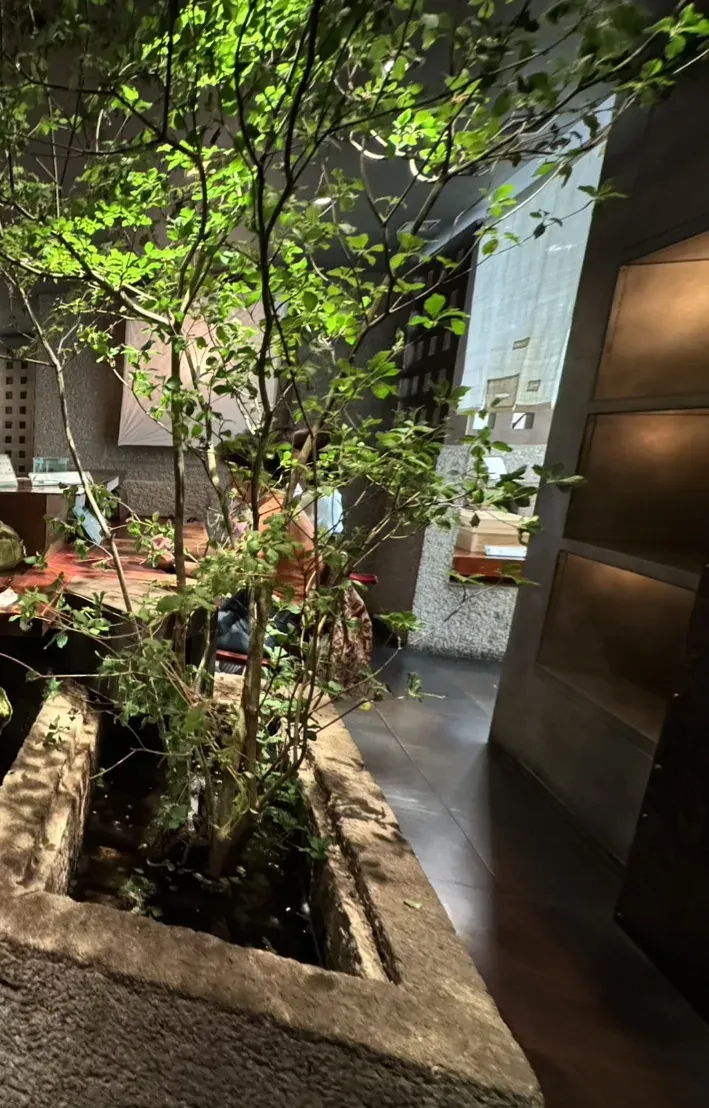
A tree grows out of a stone water basin in the middle of the floor. There is no window and no daylight; the tree is lit and watered on purpose, at some expense, by a business whose actual product is dried leaves.
If you have read the Aoyama piece you will recognise what this is. Japanese tea has a phrase for it — shichū no sankyo, a mountain dwelling in the middle of the city — and it describes exactly this move: not escaping the city, but building a room inside it that the city does not reach. It is a four-hundred-year-old idea, and here it is in a basement in 2026, three metres from a queue for cake.
What the counter does
The tea is made in front of you, which is the whole reason to sit rather than just buy and leave.
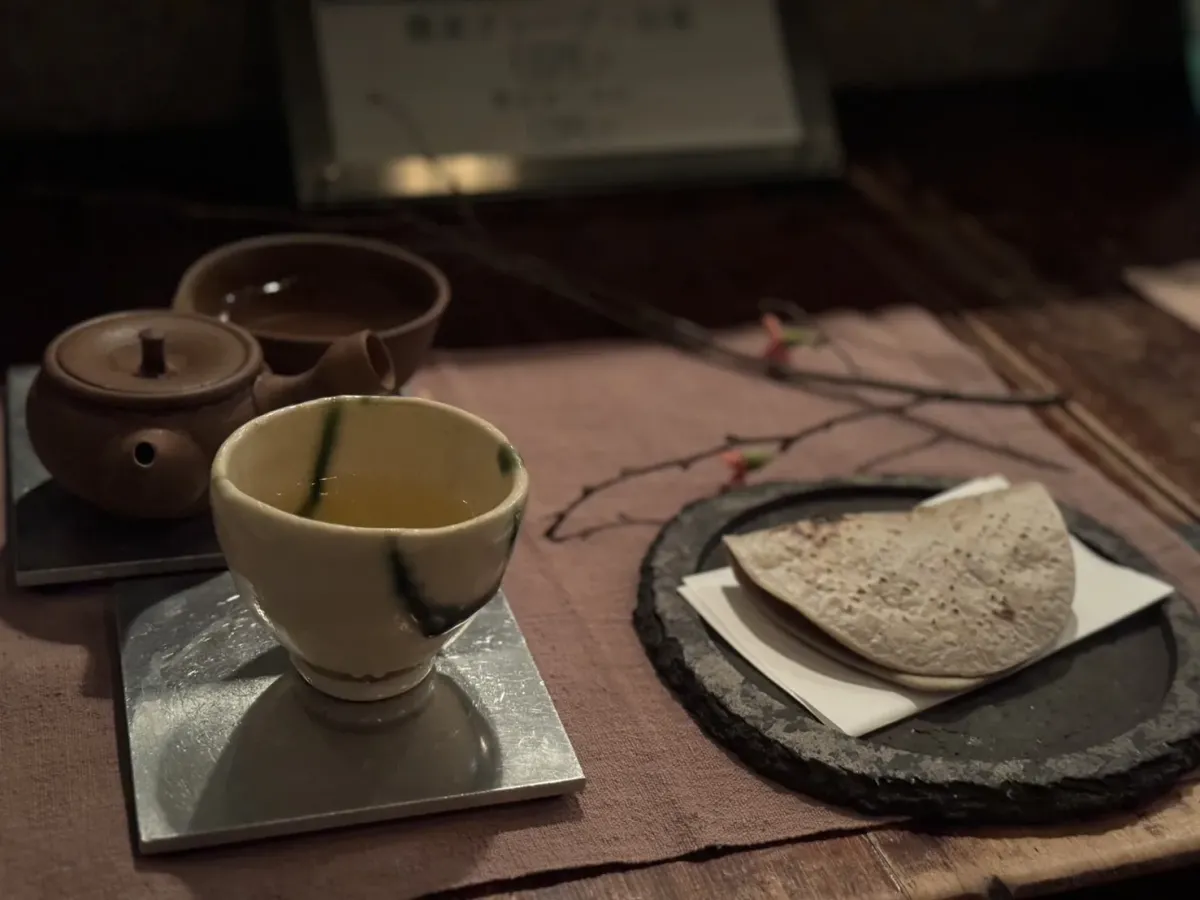
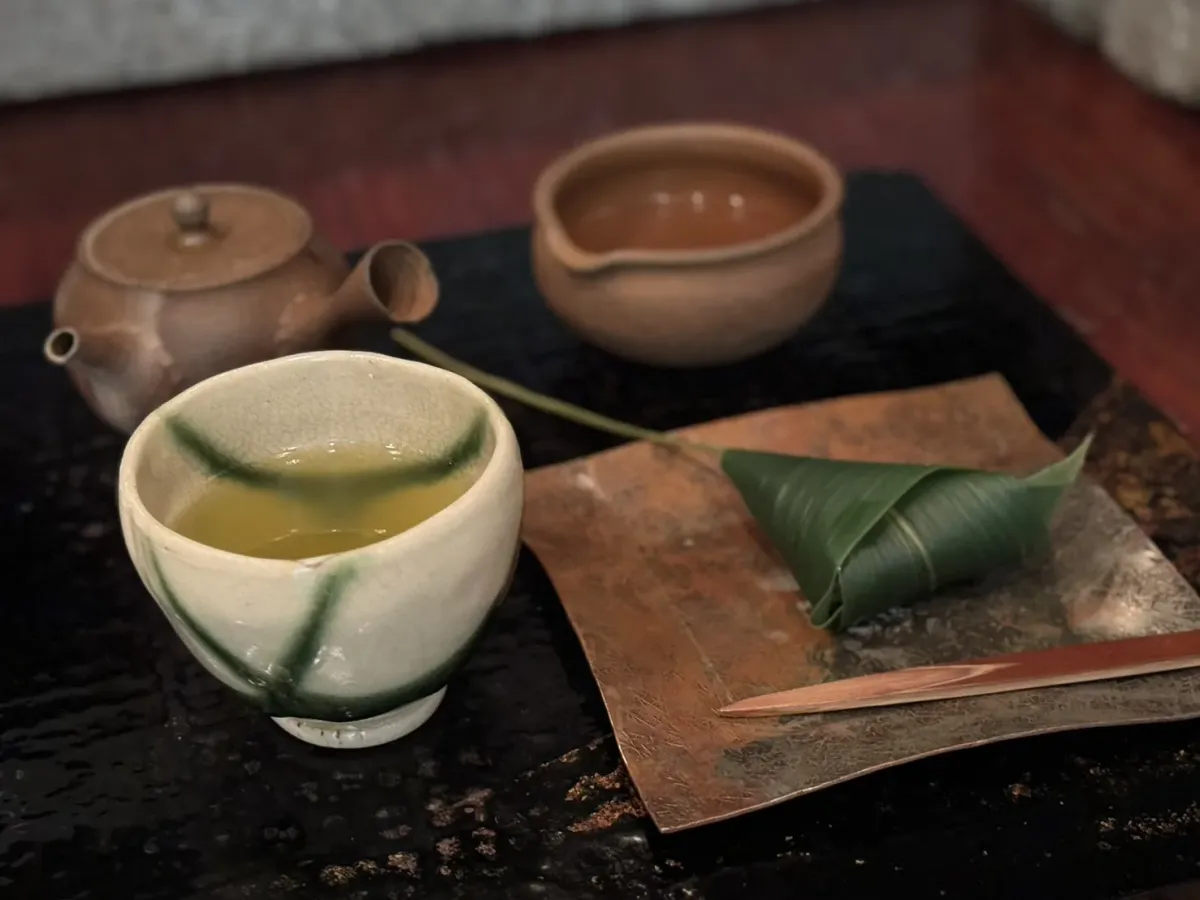
The menu rotates with the season — sencha, gyokuro, matcha — and the sweet arrives matched to the cup rather than chosen separately. The sweet in the photograph above is wrapped in a bamboo leaf, which tells you roughly what time of year it was without anyone having to say so.
What I buy, though, is always sencha. Not because the gyokuro is not worth it, but because sencha is what I actually drink on a Tuesday morning, and a tea you keep for occasions is a tea you mostly do not drink.
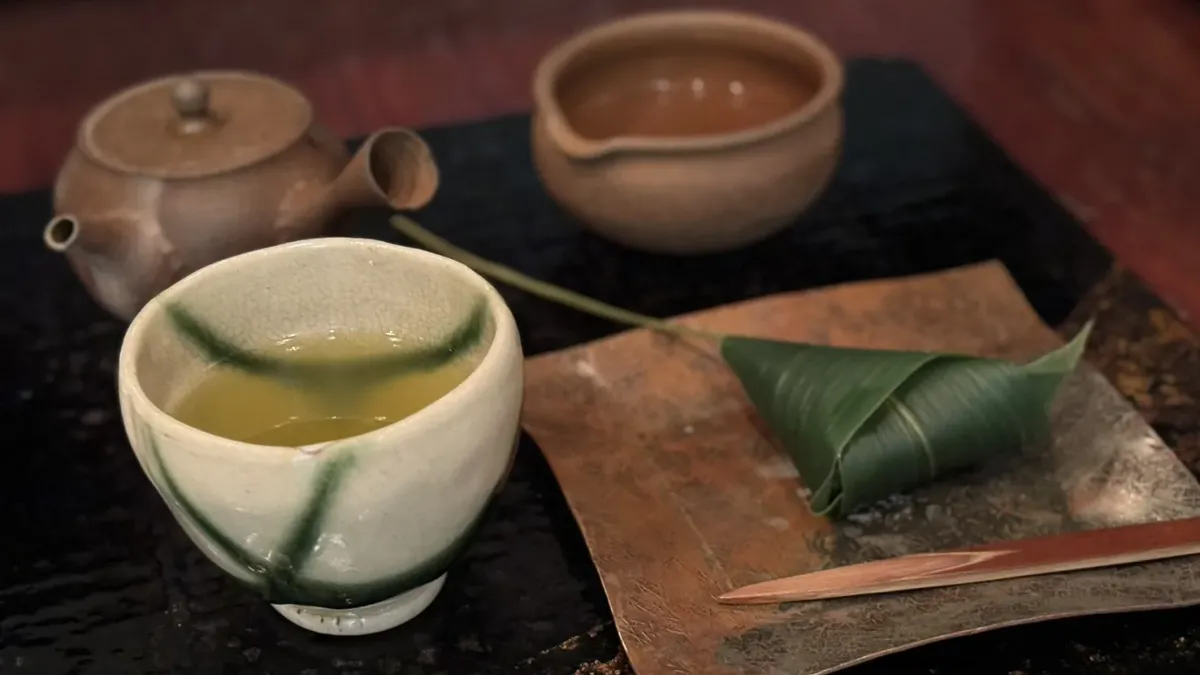
The vessel in these photographs that most people would not recognise is the small brown bowl: a yuzamashi, a cooling bowl. Water goes from the kettle into it, sits, loses heat, and only then goes to the leaf. It exists for one purpose — to stop you pouring boiling water on good tea — and watching one used every time is how the habit gets into you.
They serve the steeped leaves here too
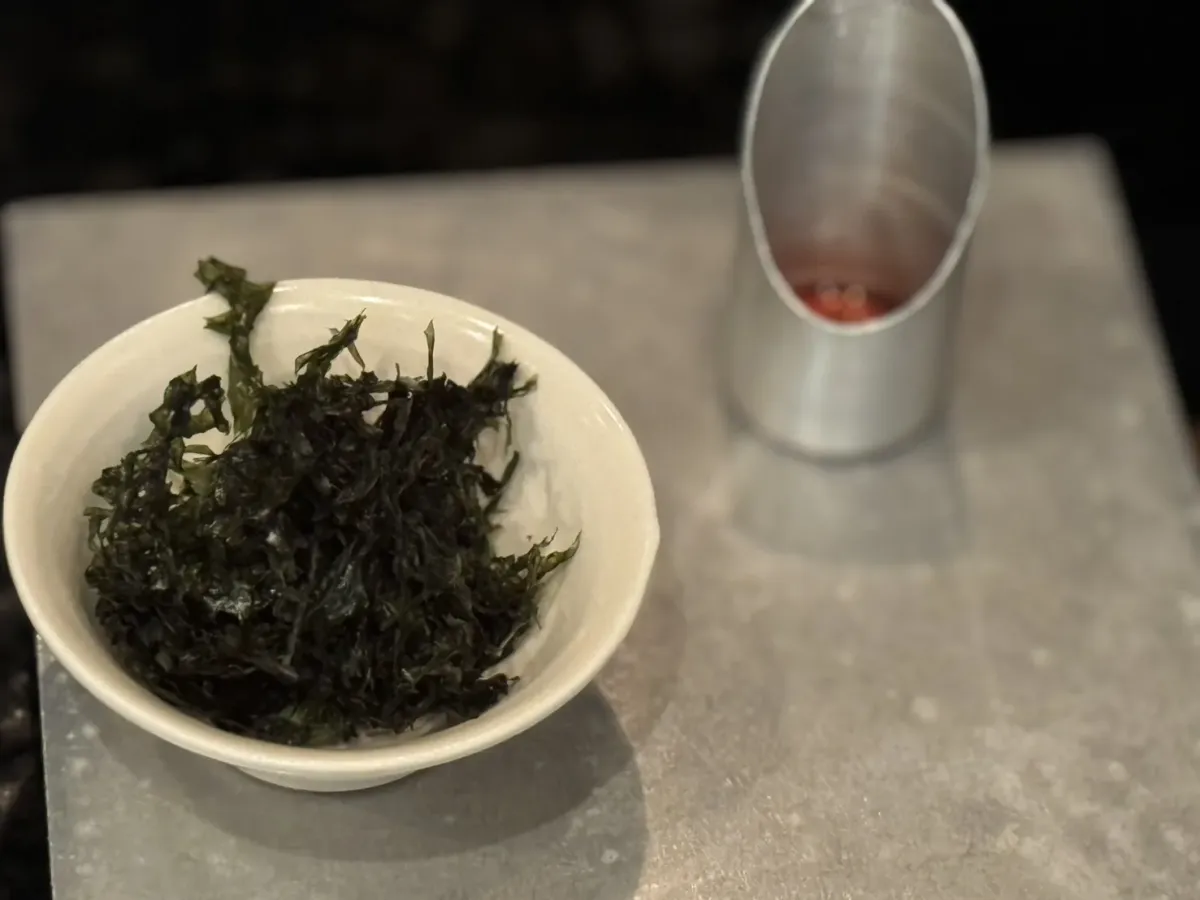
I wrote in the Aoyama piece about being handed the spent gyokuro leaves on a dish to eat, with a little salt, and how that reorganised what I do with leaf at home. I had half assumed it was that counter’s particular idea.
It is not. It happens here as well.
Which means it is not a flourish — it is simply what a Japanese tea house does when the leaf is good enough to be worth eating. If you only ever encounter Japanese tea through a bag or a tin, this is the single easiest thing to get wrong: the leaf is not packaging around the drink. It is half the ingredient, and it is food.
It is the kind of thing you only notice by going to more than one place, more than once.
Buy small, buy often — and the part I get wrong
The principle first, because it is the useful part and it applies wherever you live.
Japanese green tea does not improve on a shelf. It is not a wine or a puer; it is closer to a green vegetable that has been dried. Sencha loses aroma first and then the sweetness goes flat, and a large tin bought to save a few hundred yen will spend its last month tasting like a worse tea than you paid for.
So the thing that actually matters is not which shop you buy from. It is how recently the leaf was packed, and how fast you get through it. Buying a small amount often solves both at once.
Now the honest part: I do not manage this as well as I would like.
The right cadence here would be about once a month, and not only for freshness. The stock turns over with the season, so a monthly visit means you keep meeting things you would not have chosen — a tea that is only around for a few weeks, a sweet that marks where in the year you are. That is most of the pleasure of a shop like this.
What I actually manage is closer to once every three months. Ginza is not on my way anywhere, and three months is long enough that I miss whole seasons of what they carry. I am writing this down partly so I read it again in November.
How I choose between the two
People ask this about Tokyo tea rooms as though it were a ranking. It is not. For me it is entirely geographic.
If I have something to do in Omotesando and time to spare, I go to the counter in Aoyama. If I have something to do in Ginza and time to spare, I come here. Neither is a destination I build a day around, and I think that is the correct relationship to have with a tea house — it should be somewhere you drop into, not somewhere you make a pilgrimage to.
There is a price difference too, and it is worth being plain about it. Cha no Ha is the more affordable of the two by a clear margin, which is exactly why it is the one I can walk into without deciding to. The Aoyama counter is a course; this is a cup of tea.
If you are going
It is on B1 of Matsuya Ginza. Counter only, under ten seats.
It is also genuinely not famous, which is its best feature. A short queue usually gets you in — and a short queue in Ginza on a Saturday, for a quiet room with a tree in it, is one of the better trades available in that part of the city.
You do not need to speak Japanese to be looked after here. Pointing at what the person next to you is drinking has never once failed me as a strategy.
Can you buy from them from abroad?
As far as I can tell, no. Their online shop has English pages, but I have found nothing indicating they ship outside Japan, and I would rather tell you that than let you find out at the checkout. I will ask at the counter next time I am there and correct this if I am wrong.
So this is a place to go to, not a place to order from — and if you are not coming to Tokyo, the part of this worth taking is not the shop. It is the habit: buy a small amount, buy it often, and drink it while it is still recent. Any decent tea seller near you will do more for your cup than a large tin of something excellent that has been open since spring.
Related
- The tea counter I keep going back to — the other place, and what it changed at home